Our research focuses on the physics of living systems. The group combines experimental and theoretical approaches to investigate microbial communities, single-cell behavior, and gene regulation, with an emphasis on how bacteria organize, interact, and adapt to dynamic environments. Current studies explore from the collective dynamics of multispecies bacteria and robot swarms to cellular decision-making, aiming to uncover the fundamental principles that govern complexity, variability, and organization in biological systems.
Di Patti F., Arbel-Goren R., Fanelli D. & Stavans J.
(2026)
Physics Reports.
1179,
p. 1-64
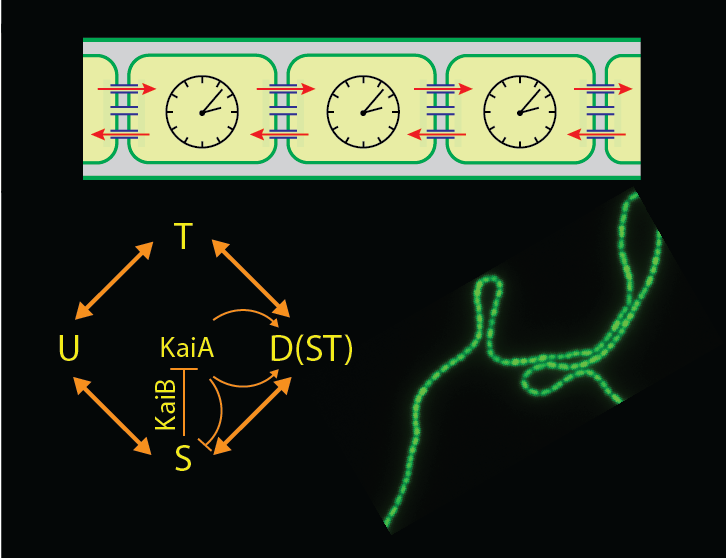
Patterns in time and space spanning a wide range of scales abound in nature, from the circadian oscillations in cyanobacteria to epidemic cycles, from the exquisite skins in zebras to the spatial structure of ecological habitats. For many of these systems, deterministic descriptions may necessitate fine tuning of parameters in order for patterns to form, in a way that is incompatible with their observed natural robustness. Furthermore, endogenous stochasticity such as that coming from fluctuations in small copy numbers of the interacting basic variables may be significant for these systems, in addition to external sources of noise that act as a macroscopic bias to deterministic, reproducible dynamics. Here we survey natural systems for which demographic noise has been shown to be important, and for which an individual-based description that is intrinsically stochastic is needed. This amounts to characterizing their microscopic dynamics via master equations, which return the probability for observing a system in a given state, at a given time. The application of perturbative expansions to obtain approximate analytical and numerical solutions of the master equations describing these specific systems, shows how the effects of demographic noise emerge in a perturbative fashion, and how endogenous stochasticity can be self-consistently amplified, yielding almost regular oscillations, termed quasi-cycles. These quasi-cycles appear for parameter values that lie outside the regions in parameter space where deterministic oscillations are predicted, thereby enhancing robustness. Thus, counter intuitively, noise can organize in regular quasi-periodic orbits, thereby building macroscopic order from microscopic disorder. This intriguing concept, introduced for the temporal domain, can be extended to the realm of spatial systems: demographic noise can seed the emergence of stochastic Turing patterns, which have been observed in systems ranging from developmental patterns, hallucinations to microbial biofilms. We illustrate the analytical approach by making reference to simple toy models and highlight the constructive role that demographic noise can play in seeding stochastic self-organized patterns in specific systems, both in time and space.
Gallardo-Navarro O., Arbel-Goren R., August E., Olmedo-Alvarez G. & Stavans J.
(2025)
Nature Communications.
16,
1,
950.
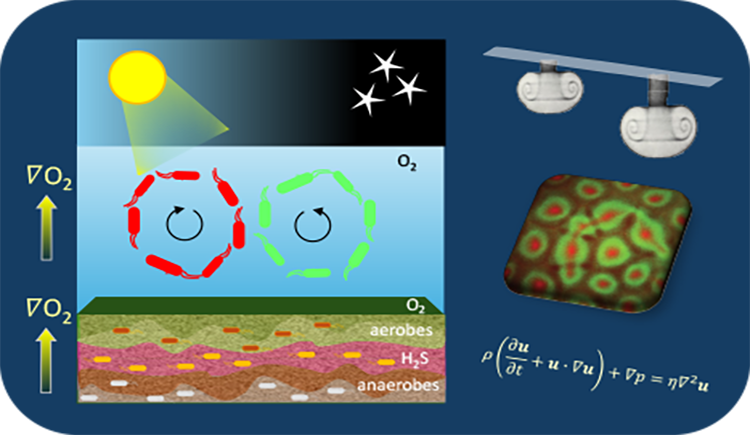
Active matter, from motile bacteria to animals, can exhibit striking collective and coherent behavior. Despite significant advances in understanding the behavior of homogeneous systems, little is known about the self-organization and dynamics of heterogeneous active matter, such as complex and diverse bacterial communities. Under oxygen gradients, many bacterial species swim towards air-liquid interfaces in auto-organized, directional bioconvective flows, whose spatial scales exceed the cell size by orders of magnitude. Here we show that multispecies bacterial suspensions undergoing oxytactic-driven bioconvection exhibit dynamically driven spatial segregation, despite the enhanced mixing of bioconvective flows, and the fact that these species coexist in their natural habitat. Segregation is observed as patterns of spatially interlocked domains, with local dominance of one of the constituent species in the suspension. Our findings suggest that segregation mechanisms are driven by species-specific motile behaviors under conditions of hydrodynamic flow, rather than biochemical repulsion. Thus, species with different motile characteristics in the same ecological context can enhance their access to limiting resources. This work provides novel insights on the role of heterogeneity in active matter, as well as on the dynamics of complex microbial communities, their spatial organization and their collective behavior.